What Are Slip Resistant Shoes: Safety Guide
Introduction
Slip-resistant shoes are shoes made to help your feet grip wet, greasy, oily, or smooth floors. They use a special outsole, tread pattern, and rubber compound to lower the risk of slips and falls.
In the United States, these shoes are common in restaurants, hospitals, grocery stores, factories, warehouses, and other workplaces with slick floors. They can also help at home, especially in kitchens, garages, and outdoor areas.
A slip-resistant shoe does not make every surface safe. It only improves traction under certain conditions. The fit, tread, floor type, liquid, walking speed, and shoe condition all affect performance.

How Do Slip-Resistant Shoes Work?
Slip-resistant shoes work by helping the outsole maintain contact with the floor. Their design usually combines three parts:
- A rubber or rubber-like outsole with good grip
- Tread grooves that move liquid away from the contact area
- A pattern that gives the foot more edges to grip the floor
Think of the outsole as a tire. A smooth tire has less control on a wet road. A treaded tire can move water away and keep more rubber in contact with the road. Slip-resistant footwear uses a similar idea, though floor traction is more complex than road traction.
Slip-resistant outsole materials
Many slip-resistant shoes use soft rubber or specially blended rubber. These materials can grip hard floors better than hard plastic or smooth leather.
Soft rubber may perform well on:
- Wet tile
- Sealed concrete
- Vinyl floors
- Kitchen floors
- Polished indoor surfaces
However, a soft outsole may wear faster. It may also collect grit, grease, or food debris. That dirt can reduce traction.
Tread pattern and drainage
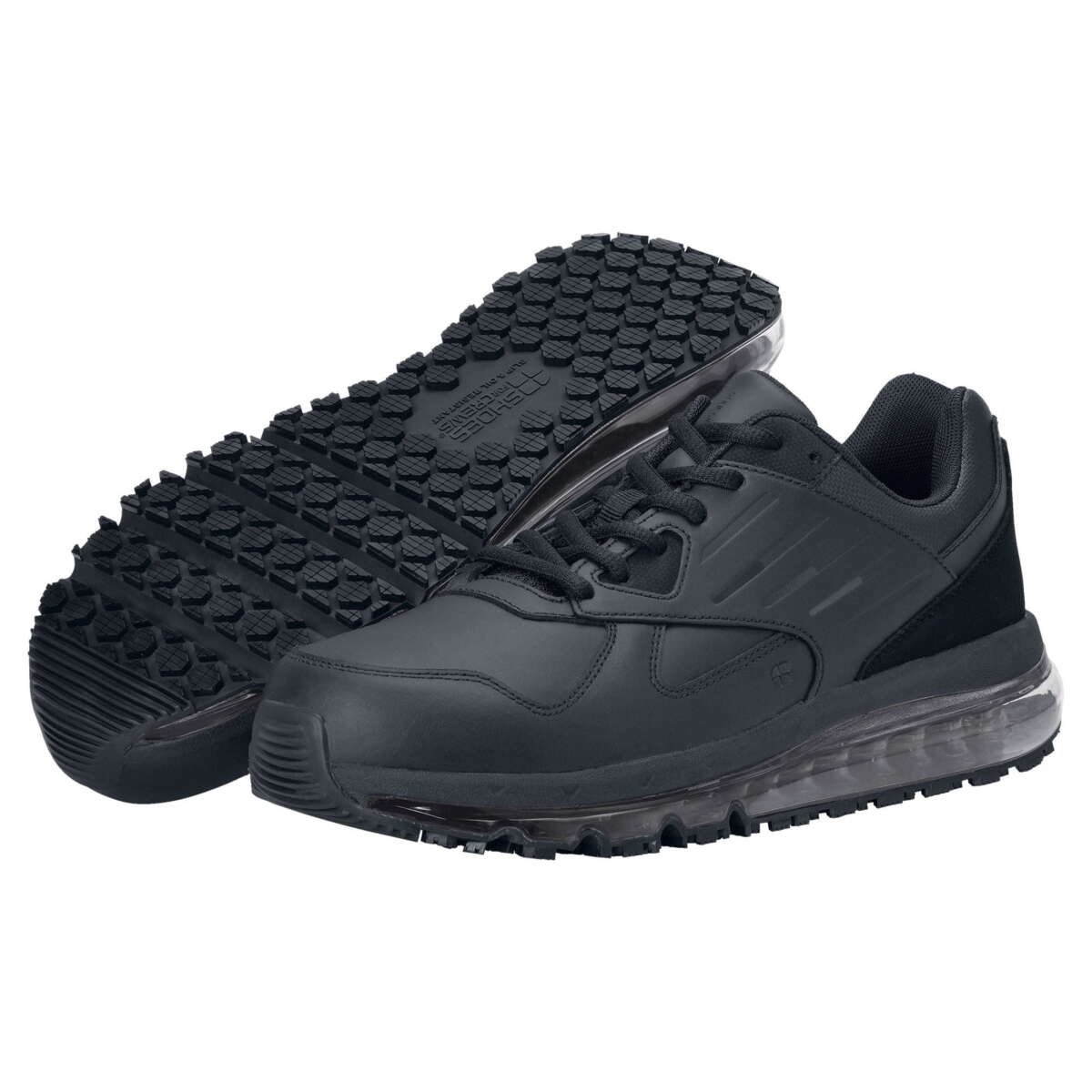
The tread pattern helps move water, oil, and other liquids away from the area under your foot. Small grooves and channels may help the outsole keep contact with the floor.
A useful tread often has:
- Many small contact areas
- Channels that do not trap liquid
- Rounded or beveled edges
- Enough space between grooves for cleaning
Deep tread is not always better. Large, deep lugs may work well outdoors but can perform poorly on smooth indoor floors. For restaurant or hospital work, a flatter tread with many small channels is often more useful.
Heel and forefoot design
The heel and ball of the foot carry much of the load during walking. A slip-resistant shoe should provide grip in both areas.
A wide contact area can help with balance. A stable heel can also reduce side-to-side movement. These features do not replace good walking habits, but they may improve control.

What Makes a Shoe Slip Resistant?
A shoe is more likely to resist slips when it has a tested outsole, a suitable tread, a secure fit, and a design that matches the work surface. A label alone does not prove that it will work well in every setting.
Look for a real slip-resistance claim
Terms such as these may appear on a shoe:
- Slip resistant
- Slip resistant outsole
- Oil resistant
- Wet-grip outsole
- Traction outsole
- Tested for slip resistance
These terms can help you find suitable shoes, but they are not all equal. “Oil resistant” may refer to the outsole’s resistance to oil damage, not its ability to prevent slipping on an oily floor.
Read the product details carefully. Look for information about:
- The test method used
- The floor and liquid used in testing
- Whether the whole shoe or only the outsole was tested
- The limits of the claim
- Care instructions
Understand U.S. testing terms
ASTM F2913 is a U.S. test method used to measure the slip resistance of footwear on selected surfaces and under selected conditions. It can provide useful test data, but it does not mean the shoe will prevent every slip.
ASTM F3445 covers performance and labeling for slip-resistant footwear. A product that refers to a recognized standard may offer more useful information than one that only uses vague marketing language.
The Occupational Safety and Health Administration, or OSHA, does not give every work shoe a universal “OSHA approved” label. OSHA requires employers to assess workplace hazards and provide suitable personal protective equipment when needed. OSHA’s general foot-protection rules focus on hazards such as falling objects, punctures, and electrical risks. Slip protection depends on the workplace hazard assessment.
Check the tread by sight
A good indoor work outsole often has a pattern with many grooves and channels. The tread should not look fully smooth.
Avoid a worn outsole with:
- Flat spots
- Missing tread
- Cracks
- Hardened rubber
- Smeared or rounded edges
- Deep cuts
- Uneven wear
A shoe may still look clean while its rubber has become hard. Hard rubber often gives less grip than fresh rubber.
Check the fit
A loose shoe can slide inside the shoe even when the outsole grips the floor. A tight shoe can cause pain and change the way you walk.
A useful fit check is simple:
- Try the shoes on near the end of the day, when feet may be slightly larger.
- Wear the socks you plan to use at work.
- Make sure your heel stays in place as you walk.
- Leave room for your toes to move.
- Check that your foot does not slide forward or side to side.
- Walk on a clean, dry surface before deciding.
A stable fit supports traction. It does not create traction by itself.

Are Slip-Resistant Shoes the Same as Non-Slip Shoes?
Yes, the terms usually refer to the same broad type of footwear. “Slip resistant” is the more precise term because no shoe can remove all risk of slipping.
“Non-slip” is common retail language. It may describe a shoe with a traction outsole, but the term does not always explain how the shoe was tested.
The best way to judge a shoe is to look past the name. Check the outsole material, tread, test information, user instructions, and work environment.
Slip-Resistant vs. Oil-Resistant vs. Waterproof Shoes
These terms describe different features. One shoe may have all three, but one feature does not prove the others.
| Feature | What it means | What it does not guarantee |
|---|---|---|
| Slip resistant | The shoe is designed or tested to improve traction | It will prevent every slip |
| Oil resistant | The outsole resists damage or breakdown from oil | It will grip every oily floor |
| Waterproof | Water is blocked from entering for a stated period or condition | The outsole will resist slipping |
| Water resistant | The shoe limits water entry but may not block it fully | The shoe is waterproof |
| Safety toe | The toe has protection against certain impact or compression hazards | The shoe is slip resistant |
| Electrical hazard rated | The shoe may reduce certain electrical risks under stated test conditions | It protects against every electrical hazard |
A waterproof boot can still be slippery. A slip-resistant work shoe may not be waterproof. Choose each feature for a specific hazard.

Where Are Slip-Resistant Shoes Most Useful?
Slip-resistant shoes are most useful where floors may become wet, greasy, oily, soapy, or polished.
Common settings include:
- Restaurants and commercial kitchens
- Cafeterias and food-service areas
- Hospitals and nursing homes
- Grocery and retail stores
- Hotels and housekeeping work
- Warehouses and loading areas
- Manufacturing plants
- Auto shops
- Cleaning and janitorial work
- Home kitchens and garages
The correct shoe depends on the floor and the hazard. A restaurant worker may need a low-profile outsole that handles grease and food liquids. A warehouse worker may need slip resistance plus a safety toe. A hospital worker may want traction, comfort, easy cleaning, and long standing support.
How to Choose Slip-Resistant Shoes
Start with the floor and the hazard, not the brand name. The right choice is the one that matches the conditions you face.
1. Identify the main hazard
Ask what makes the floor unsafe:
- Water
- Oil or grease
- Soap
- Food waste
- Dust
- Metal particles
- Ice
- Uneven ground
- Falling objects
- Electrical exposure
If falling objects or punctures are possible, slip resistance alone is not enough. You may need protective footwear that meets the employer’s safety rules.
2. Match the outsole to the floor
For smooth indoor floors, look for a rubber outsole with many small grooves. For outdoor work, a more rugged tread may help with dirt, gravel, and uneven ground.
Be careful with very deep outdoor lugs on smooth floors. The shape may offer less steady contact than a flatter indoor work tread.
3. Consider liquids and cleaning
If you work around grease, choose a shoe made for food-service or oil-exposed conditions. Check whether the manufacturer gives care instructions for grease and chemical exposure.
Clean the outsole often. Dirt can fill the grooves and reduce the tread’s ability to grip.
4. Check other safety needs
You may also need:
- A protective toe cap
- Puncture-resistant construction
- Electrical hazard protection
- An ankle-supporting design
- A waterproof membrane
- Heat-resistant materials
- A removable insole
- A secure lace or closure system
Do not assume one safety feature includes another. Check the exact product specification.
5. Test the fit and walking feel
Walk, turn, stop, and climb a few steps if possible. The heel should stay secure. The shoe should bend near the ball of the foot, not in the middle.
If the shoe pinches, slips inside, or changes your natural stride, try another size or shape. Discomfort can lead to poor movement and fatigue.

How to Test Slip-Resistant Shoes Safely
You can perform a basic check at home, but it will not replace a controlled laboratory test.
First, inspect the outsole. Make sure it is clean and free from damage. Then walk slowly on a clean, dry floor. Check whether your foot feels stable during straight steps and gentle turns.
Do not pour oil, soap, or water on the floor to create a test area. That can cause a real fall and may damage the floor. If your job has a known spill hazard, ask your safety manager whether the footwear has been tested for that condition.
A shoe that feels secure on dry tile may not perform the same way on greasy concrete. Traction changes with the liquid, floor material, temperature, pressure, and angle of the foot.
Common Mistakes With Slip-Resistant Shoes
Mistake 1: Treating “non-slip” as a guarantee
No shoe prevents every fall. A shoe may perform well in one test but poorly on a different floor or liquid.
Mistake 2: Choosing a smooth outsole
A smooth outsole may look easy to clean, but it often has fewer edges to help grip a wet floor.
Mistake 3: Ignoring worn tread
Once the grooves become shallow or smooth, the shoe may no longer provide the same traction.
Mistake 4: Using the wrong shoe for the job
A lightweight kitchen shoe may not protect against falling tools. A rugged work boot may feel unstable on a smooth indoor floor. Match the shoe to the full hazard list.
Mistake 5: Failing to clean the outsole
Grease, dust, and small debris can fill tread channels. Clean the outsole based on the maker’s instructions.
Mistake 6: Walking through spills
Slip-resistant footwear reduces risk. It does not make a spill safe. Follow workplace spill procedures and report hazards promptly.