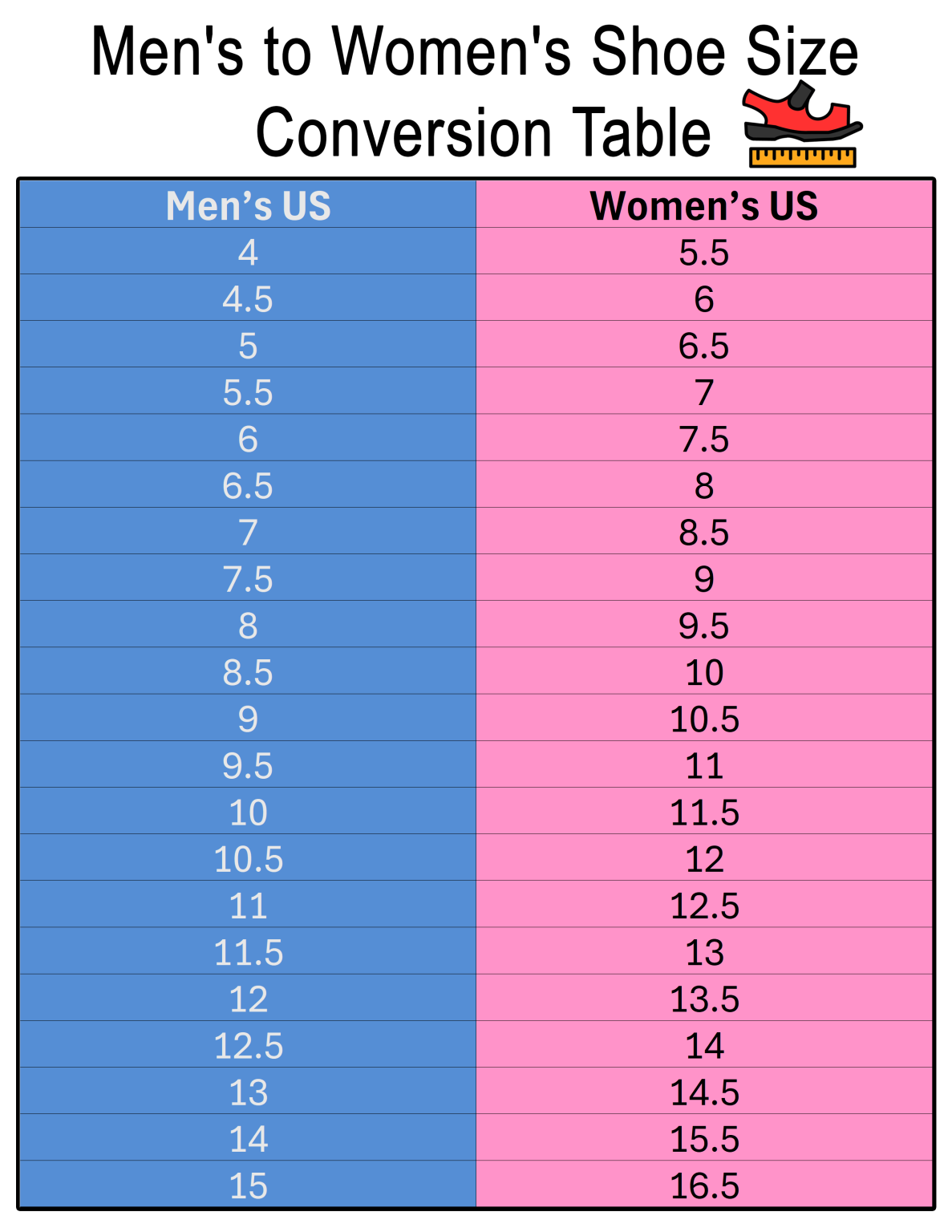
In the United States, a women’s sneaker is usually about 1.5 US sizes larger than the equivalent men’s sneaker. For example, a men’s size 8 often matches a women’s size 9.5. However, this is only a starting point. Brand charts, shoe shape, width, and foot measurements can change the best fit.
The safest method is to convert the size, then check the brand’s own chart and compare the shoe’s length and width with your foot.
The basic men’s-to-women’s sneaker conversion
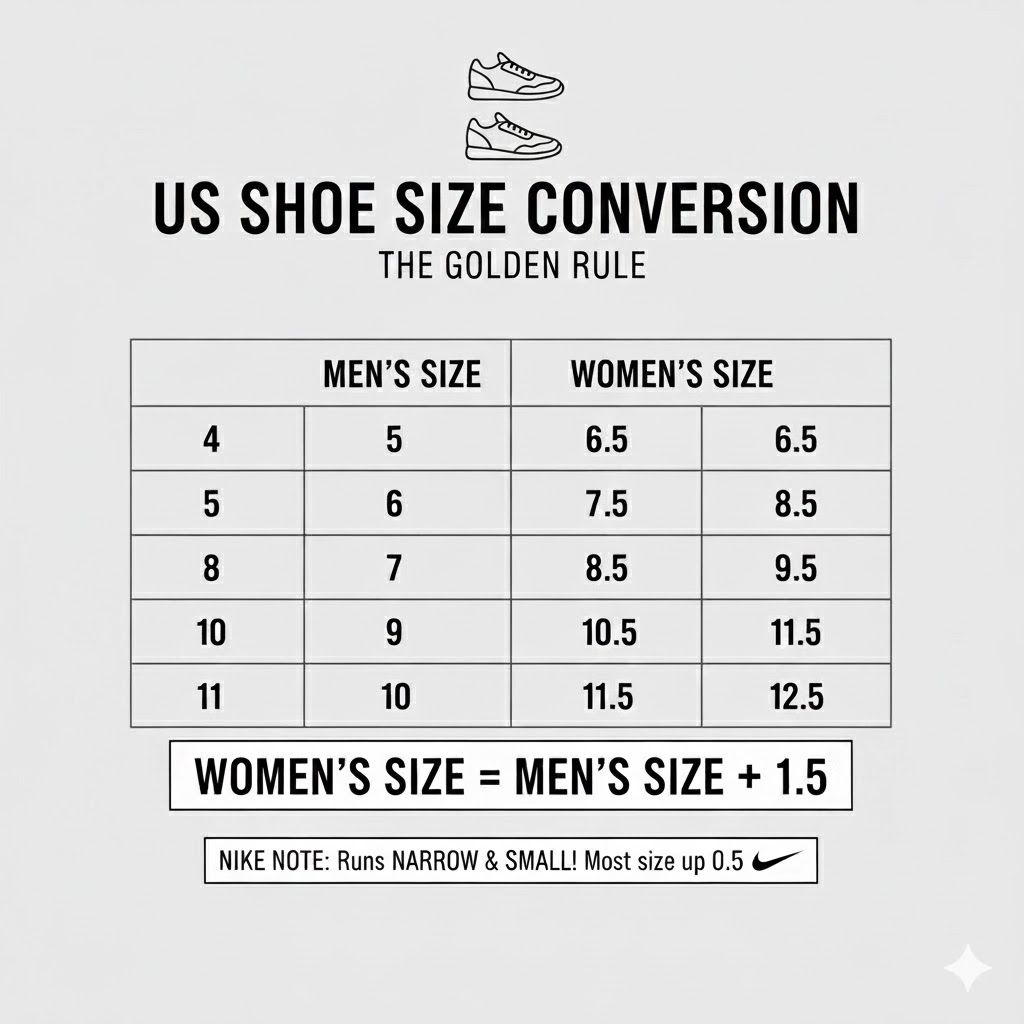
For most US sneaker brands, use this simple formula:
Women’s size = Men’s size + 1.5
| Men’s US size | Approximate women’s US size |
|---|---|
| 5 | 6.5 |
| 5.5 | 7 |
| 6 | 7.5 |
| 6.5 | 8 |
| 7 | 8.5 |
| 7.5 | 9 |
| 8 | 9.5 |
| 8.5 | 10 |
| 9 | 10.5 |
| 9.5 | 11 |
| 10 | 11.5 |
| 10.5 | 12 |
| 11 | 12.5 |
| 11.5 | 13 |
| 12 | 13.5 |
| 13 | 14.5 |
To convert in the other direction:
Men’s size = Women’s size − 1.5
So, a women’s size 10 is roughly equal to a men’s size 8.5.
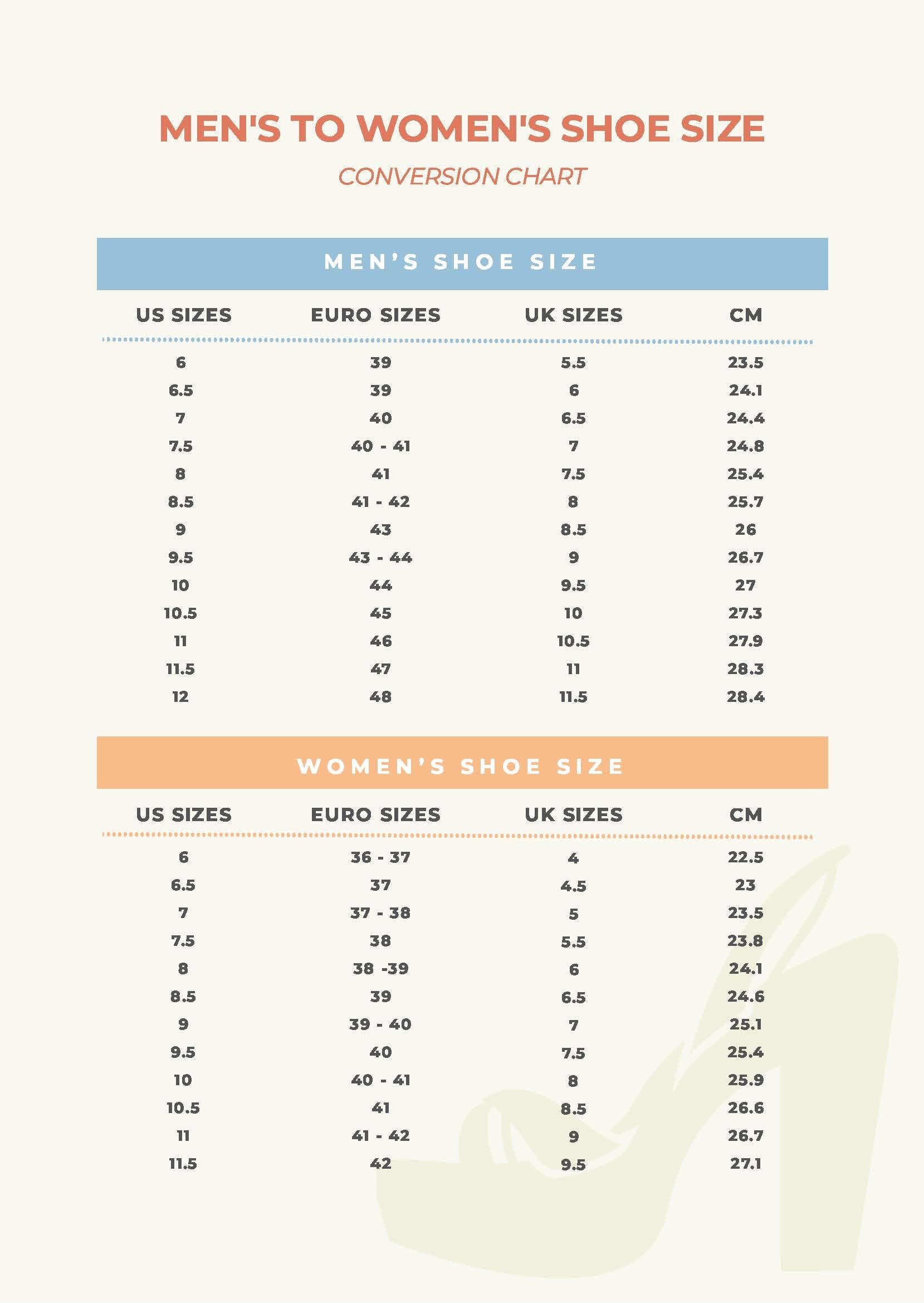
This rule applies most often to US sizes. UK, EU, and centimeter sizes do not always follow the same pattern, so do not apply the US formula to another sizing system.
Why the rule is only approximate
US footwear sizing is not fully uniform between brands. One company may use a 1-size difference, while another may use a 1.5-size difference. The same number may also feel different because of the shoe’s shape, materials, cushioning, and intended use.
Always check the size chart for the exact sneaker. A conversion chart can point you to the right range, but it cannot replace a fit check.
Men’s and women’s sneakers may differ in width
The biggest mistake is treating the conversion as a length-only issue. Men’s and women’s sneakers can use different standard widths.
In common US width labels:
- Men’s standard width: D
- Women’s standard width: B
- Men’s wide width: 2E
- Women’s wide width: D
This means a converted men’s sneaker may feel wider than a women’s sneaker of the same foot length. That extra room can help if you have broad feet, but it may cause heel slip or foot movement if your feet are narrow.
A women’s sneaker may also have a narrower heel or midfoot. The exact design depends on the brand and model, so width labels are useful but not perfect predictors of fit.
Width conversion example
Suppose you normally wear a women’s 9.5 in a standard B width. The approximate men’s equivalent is a men’s 8 in a standard D width.
The length may be close, but the men’s shoe could feel wider. You may need to:
- Choose a narrower width if the brand offers one.
- Use a snugger lacing method.
- Try a different model with a narrower heel.
- Keep the women’s version if the shape fits better.
Do not size down simply to fix excess width. A smaller shoe may press against your toes even if the middle feels secure.

How to convert men’s sneakers to women’s sneakers step by step
Use this process when shopping online or comparing a pair you already own.
1. Confirm the sizing system
Look for US, UK, EU, or CM near the size. The 1.5-size rule is for US men’s and women’s sizing.
If a listing says only “size 8,” do not assume it is a US men’s size. Marketplace listings can leave out the region or use the seller’s local system.
2. Start with the 1.5-size conversion
Add 1.5 to the men’s US size.
For example:
- Men’s 7 → women’s 8.5
- Men’s 8 → women’s 9.5
- Men’s 9 → women’s 10.5
If the brand is known to use a different conversion, follow its chart instead.
3. Measure both feet
Feet are often slightly different sizes. Measure them at the end of the day, when they may be a little larger than in the morning.
You will need:
- A sheet of paper
- A pencil
- A ruler or tape measure
- The socks you plan to wear
Place the paper on a hard floor. Stand with your heel lightly against a wall, trace around each foot, and measure from the heel to the longest toe. Measure the widest part of each foot as well.
Use the larger foot when choosing a size.
4. Compare your measurements with the brand chart
Brand charts may list:
- Heel-to-toe length
- Foot length in centimeters
- US men’s sizes
- US women’s sizes
- Width options
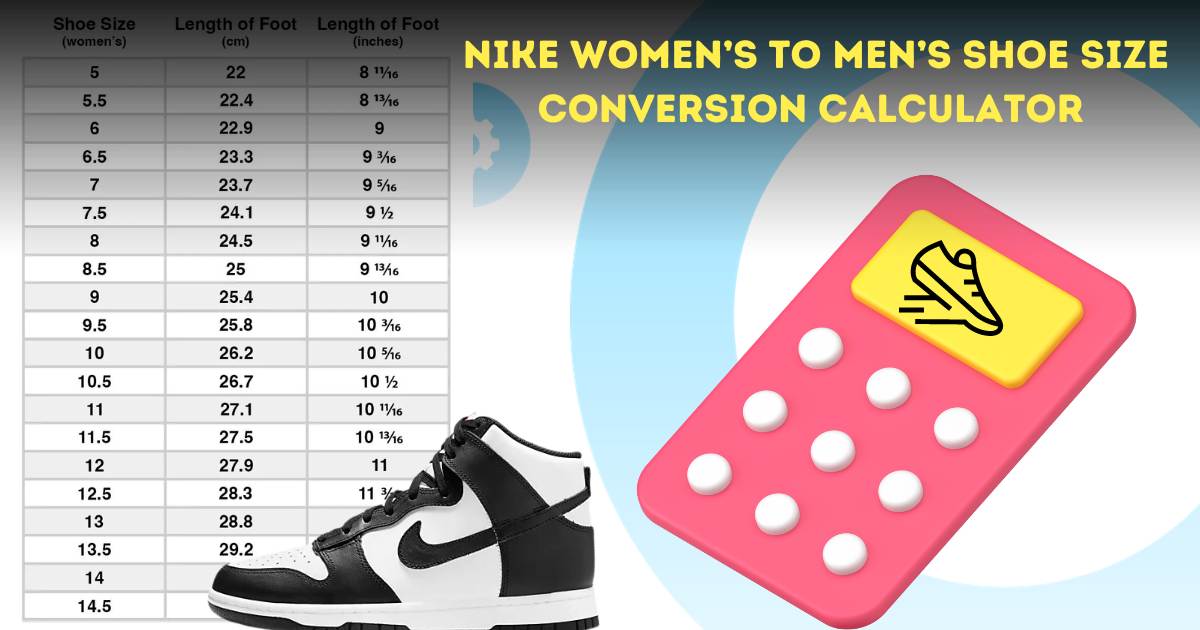
A centimeter measurement is often more useful than a gender label because it focuses on foot length. Still, the chart may describe the shoe’s internal fit differently from another brand’s chart.
5. Check the shoe’s width and shape
Read the product details for width options such as narrow, standard, wide, or extra wide. Also consider whether the shoe has:
- A narrow or roomy toe box
- A padded or shallow upper
- A firm heel counter
- A flexible or rigid sole
- A high or low instep
These features can affect fit as much as the size number.
6. Try the shoes with normal socks
Wear the socks you expect to use. Lace the shoes fully, stand up, and walk for several minutes.
Do not judge the fit while sitting. Your feet spread and lengthen slightly when you stand and walk.

How a properly converted sneaker should fit
A converted sneaker fits well when your foot feels held in place without pressure or numbness.
Use these checks:
- Your toes should not touch the front when standing.
- Your longest toe should have a small amount of free space.
- Your heel should stay mostly in place while walking.
- The widest part of your foot should sit over the widest part of the shoe.
- The upper should not create sharp pressure points.
- Your toes should be able to move without being squeezed together.
- Your arch should feel supported by the shoe’s shape, not forced into it.
A little heel movement can occur in a new shoe, but repeated slipping may lead to blisters. Try a different lacing pattern before changing size. If the front feels short, do not keep the shoe because it may “break in.” Materials may soften, but they rarely create meaningful extra length.
Quick fit test
Stand in the shoes and press gently on the front of the upper. If your toes are already touching the end, the shoe is too short.
Then walk downhill or stop quickly. If your toes slide into the front, the shoe may be too long, too loose, or shaped poorly for your foot.

Men’s versus women’s sneaker sizes: key differences
The size number is not the only difference between men’s and women’s sneakers.
| Feature | Men’s sneaker, often | Women’s sneaker, often |
|---|---|---|
| Standard width | D | B |
| Heel shape | May be roomier | May be narrower |
| Midfoot shape | May offer more volume | May offer less volume |
| Size conversion | Use the women’s size plus about 1.5 | Use the men’s size minus about 1.5 |
| Best indicator | Brand chart and foot measurement | Brand chart and foot measurement |
These are common design patterns, not universal rules. Some sneakers use the same construction for all wearers and simply change the size label. Others use different lasts, which are the forms used to shape the shoe.
A men’s sneaker can be a good choice for someone with wider feet. A women’s sneaker can be a good choice for someone who prefers a narrower heel or midfoot. Fit matters more than the label.
What to do if the converted size feels wrong
The cause of a poor fit can help you decide what to change.
| Problem | Likely cause | What to try |
|---|---|---|
| Toes touch the front | Shoe is too short | Go up in length or choose a roomier model |
| Heel slips | Shoe is too wide or long | Try a narrower width or heel-lock lacing |
| Toes feel cramped | Toe box is too narrow | Choose a wider model or a different shape |
| Side pressure | Shoe is too narrow | Try a wide width or go up only if length also feels short |
| Foot slides forward | Heel is loose or sole slopes | Use heel-lock lacing or change the model |
| Arch feels misplaced | Shape does not match your foot | Try another shoe, rather than forcing the size |
| Numbness or sharp pain | Excess pressure or poor fit | Stop wearing the shoe and reassess the size |
A different size will not fix every problem. If the shoe’s shape is wrong for your foot, changing the number may create a new problem elsewhere.
When to return the shoes
Return or exchange the sneakers if:
- Your toes hit the front.
- You feel sharp pressure.
- Your feet go numb.
- The shoe causes pain during normal walking.
- Your heel lifts repeatedly.
- The upper stretches tightly across the widest part of your foot.
Try new shoes indoors on a clean surface until you know the retailer’s return rules. Some stores restrict returns after outdoor wear.
Common mistakes when converting sneaker sizes
Using the rule for UK or EU sizes
The +1.5 rule is a US conversion shortcut. It does not reliably convert UK or EU sizes.
Use the brand’s international chart instead. When possible, compare the centimeter measurement as well.
Ignoring width
A men’s size may match your foot length but still feel too broad. Check the width label and the shape of the heel and toe box.
Assuming every brand uses the same conversion
A women’s 9.5 in one brand may not feel like a women’s 9.5 in another. Size charts are brand-specific, and models within the same brand can also fit differently.
Buying based on an old pair alone
Your old sneakers may have stretched, compressed, or changed shape. Use them as a clue, not as the only measurement.
Measuring while seated
Your feet carry more load when standing. Measure while standing for a more useful result.
Choosing a smaller shoe to control width
This often creates toe pressure. Solve a width problem with width, lacing, or a different model whenever possible.
Forgetting activity and socks
Running, hiking, and court shoes may need a different fit from casual sneakers. Thick socks can also take up more space than thin liner socks.

Can you wear men’s sneakers if you normally wear women’s?
Yes. Many people choose men’s sneakers because they offer a wider fit, different colors, more size options, or a preferred design.
Start with the approximate conversion, then check width and fit. A person who usually wears a women’s 10 may begin by trying a men’s 8.5, but the correct choice could vary by brand and model.
For running or other high-impact activities, fit deserves extra care. A loose heel, cramped toes, or excessive side pressure can cause blisters and discomfort. If you have a foot condition, persistent pain, or a history of injuries, ask a podiatrist or qualified footwear specialist for individual guidance.

Can you convert women’s sneakers to men’s?
Yes. Subtract about 1.5 US sizes as a starting point.
Examples:
- Women’s 8 → men’s 6.5
- Women’s 9 → men’s 7.5
- Women’s 10 → men’s 8.5
- Women’s 11 → men’s 9.5
Then compare the width. A women’s standard shoe is often narrower than a men’s standard shoe, so the men’s version may feel roomier.
Is a men’s size 8 the same as a women’s size 9.5?
Often, yes, in US sneaker sizing. It is not guaranteed across all brands, though. Check the manufacturer’s chart before ordering, especially when buying expensive athletic shoes or shopping final sale.
Are men’s sneakers wider than women’s sneakers?
Often, but not always. Standard men’s widths are commonly wider than standard women’s widths. The exact difference depends on the brand, model, and width option.
Should I size down in men’s sneakers?
Not automatically. If the shoe feels wide but the length is correct, try a narrower width, a different model, or a heel-lock lacing method. Size down only if the shoe is also too long and the brand’s chart supports that change.
Do men’s and women’s sneakers have different cushioning?
They may, but there is no universal rule. Some models use different designs, while others use the same construction across gender labels. Check the exact model details rather than assuming the label determines the cushioning.
Do I need men’s or women’s sneakers?
Choose the pair that fits your foot best. The label is less useful than the shoe’s length, width, heel hold, toe room, and comfort during movement.
Final answer
To convert men’s sneakers to women’s sizes in the US, add about 1.5 sizes. A men’s 8 is usually close to a women’s 9.5.
Treat that number as a starting point. Confirm the brand’s chart, measure both feet while standing, check the width, and test the shoes while wearing your normal socks. The best sneaker is the one that holds your heel, gives your toes room, and causes no pain—not simply the one with the correct label.

Michael Smith is the Content Strategist behind The Style Hub, where fashion meets function. With a keen eye for trends and a passion for everyday style, he curates content that helps readers make smarter, more stylish choices—from the perfect pair of sneakers to must-have accessories. Michael specializes in breaking down fashion into practical, wearable insights, making style accessible for everyone. When he’s not researching the latest trends, he’s exploring how comfort, innovation, and timeless design come together in modern fashion.