Salt-Water sandals usually fit true to your regular U.S. shoe size, but the best fit depends on the style, your foot width, and whether you wear socks. If you are between whole sizes, check the official size chart and usually choose the larger size. The sandals should feel snug across the foot without pinching, while your heel and toes should stay inside the sole.
This guide explains how Salt-Water sandals fit, how to measure your feet in the United States, and how to fix common sizing problems.
What Are Salt-Water Sandals?
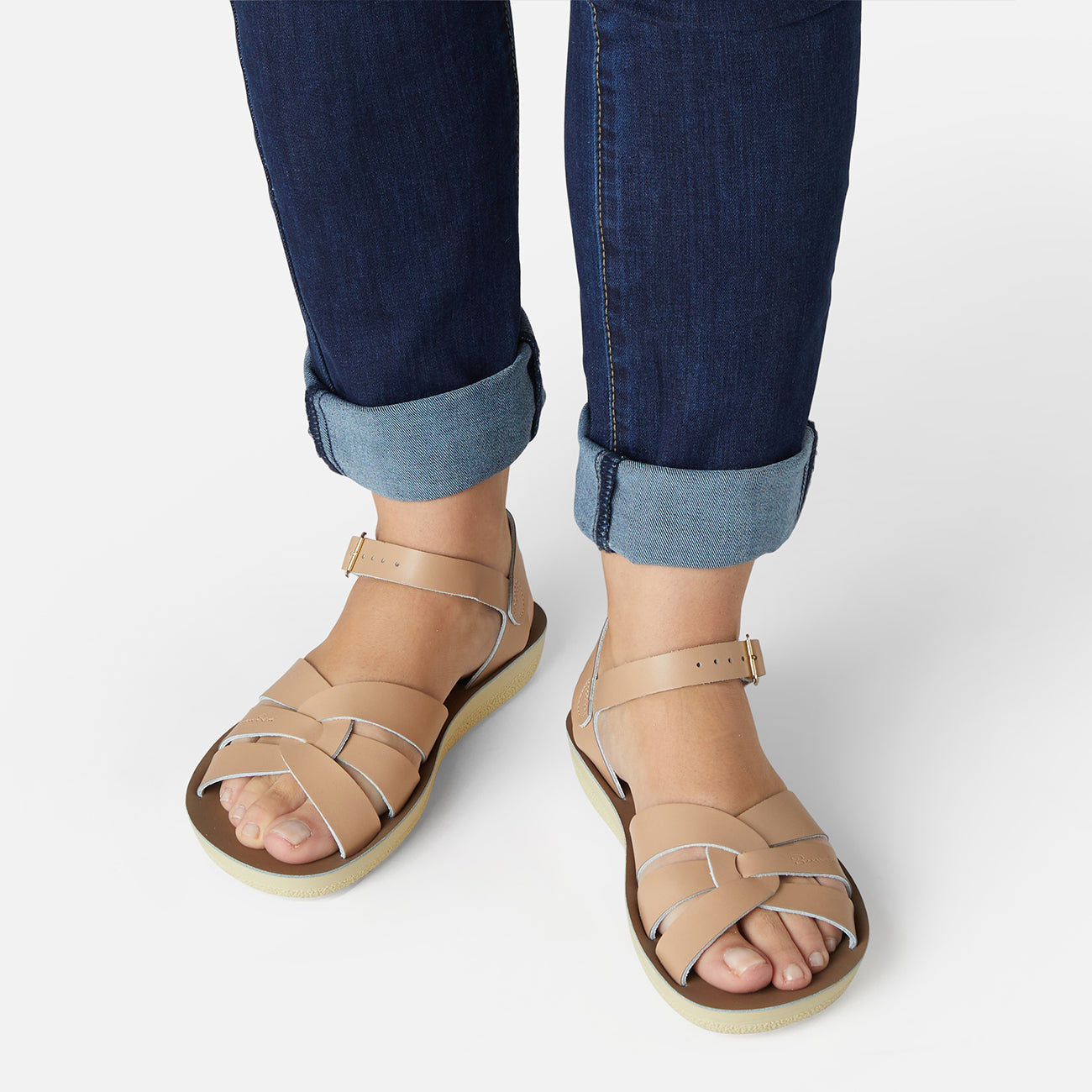
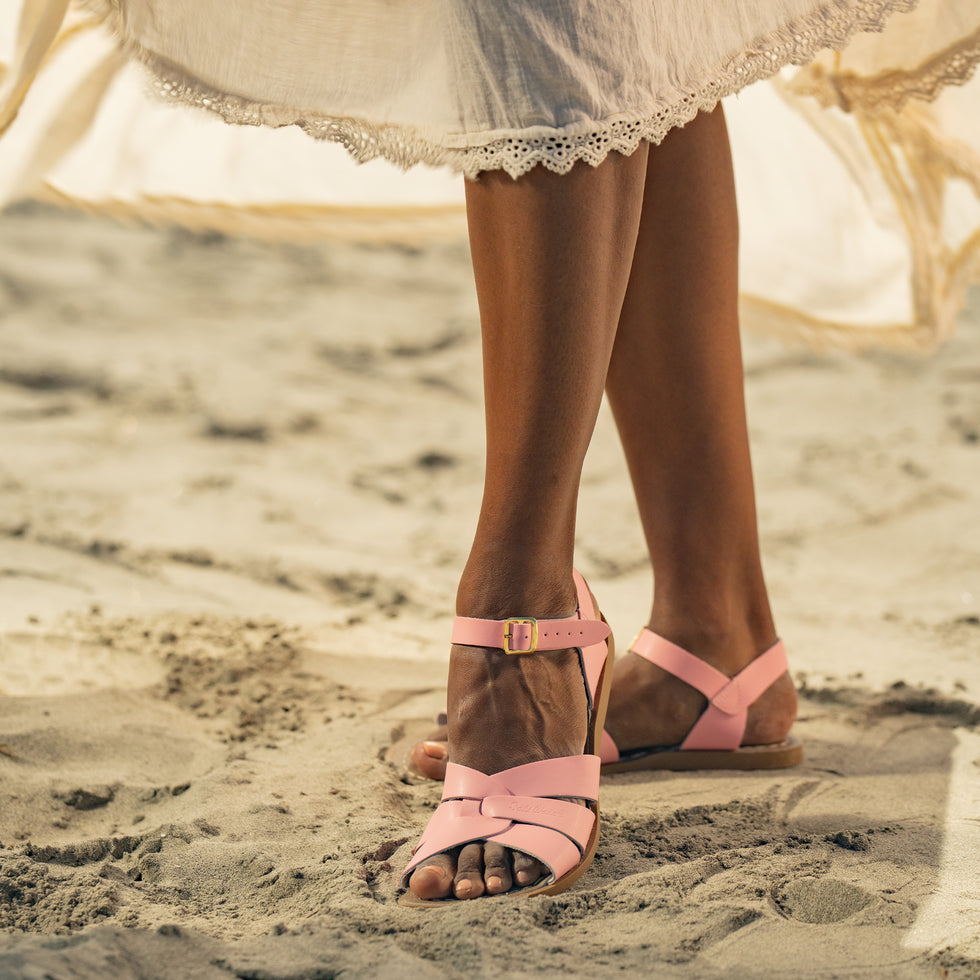
Salt-Water sandals are leather sandals made by Hoy Shoe Company. They have a rubber sole, leather straps, and a metal buckle on many styles. The name refers to their water-friendly design, not to a special foot shape or fit system.
Salt-Water sandals come in styles for women, men, and children. Common styles include:
- Original Salt-Water sandals
- Classic sandals
- Slide sandals
- Two-bar sandals
- Shark sandals
- Surfer sandals
- Sea Wees for children
Each style can fit a little differently. A closed-toe style may feel more snug than an open sandal. A slide may feel less secure than a style with an ankle strap.
The sandals are designed to fit close to the foot. They should not feel loose like a beach flip-flop. They also should not press hard on your toes or leave deep marks on your skin.
Do Salt-Water Sandals Run True to Size?
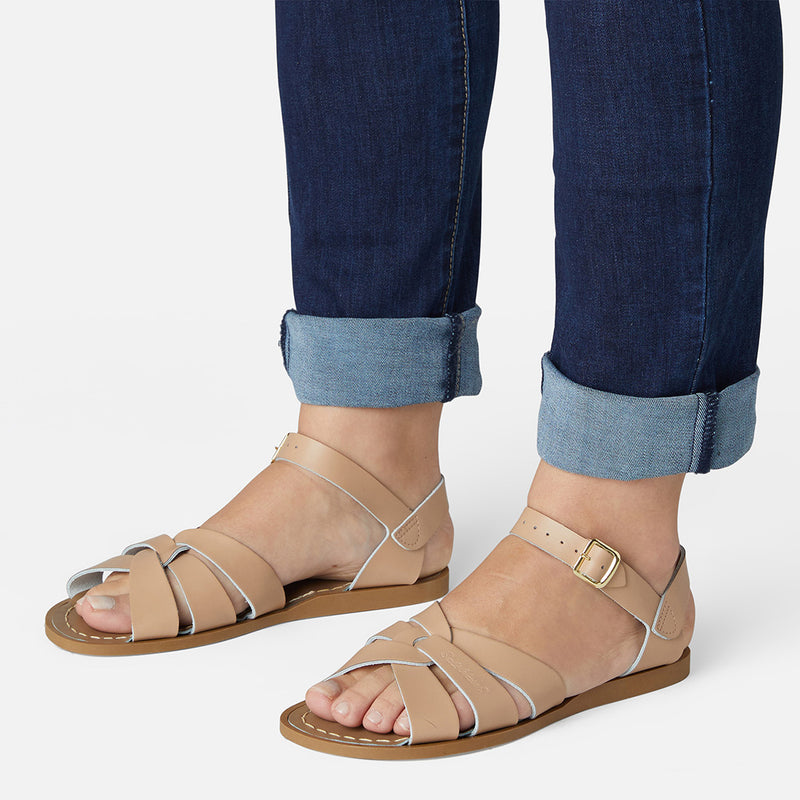
Salt-Water sandals generally run true to size in U.S. sizing. Start with the U.S. size you normally wear in sandals or casual shoes.
Still, your usual size is only a starting point. Fit can change because of:
- Foot length
- Foot width
- High or low insteps
- Half-size measurements
- The sandal style
- Socks or no socks
- Swelling during hot weather
- The amount of space you prefer
Salt-Water sandals use leather straps. Leather may soften and relax with wear, but the sandal does not usually become much longer. Do not buy a sandal that is clearly too short and expect it to stretch to the right length.
If you are between sizes, the larger size is often safer. You can adjust some styles with the buckle. A smaller sandal, however, cannot provide extra toe or heel space.
What “true to size” means
“True to size” does not mean every person will wear the same Salt-Water size as every other shoe. It means the brand’s size is close to standard U.S. shoe sizing.
For the best result, compare your foot measurement with the current chart for the exact style. Brand charts can change, and children’s and adult sizes are not interchangeable.

How Should Salt-Water Sandals Fit?
A properly fitted pair should hold your foot in place while leaving a small amount of room around the edges.
Check these four areas:
1. Your toes
Your longest toe should not touch the front edge. Your toes should also not hang over the sole.
A small gap in front of the longest toe is helpful. Too much space can make your foot slide forward when you walk.
2. Your heel
Your heel should rest on the footbed. It should not hang over the back edge.
A slight amount of extra sole behind your heel is usually less troubling than heel overhang. A large gap, however, may mean the sandal is too long.
3. The sides of your foot
Your foot should sit fully on the sole. The side of your foot should not spill over the edge.
If your foot hangs over both sides, the sandal is too narrow. Do not solve a width problem by moving up several sizes. A longer sandal may still feel narrow across the middle.
4. The straps
The straps should feel secure but not tight. You should not see strong redness, numbness, or painful pressure after a short walk.
The buckle should close without pulling the leather hard across your foot. If the strap is at its last hole on the first try, the sandal may not be the right size or style for you.

How to Measure Your Feet for Salt-Water Sandals
Measure your feet at home before ordering. This is especially useful when buying online or when your feet are different sizes.
What you need
- A sheet of paper larger than your foot
- A pencil
- A ruler or tape measure
- The socks you plan to wear, if any
- A flat wall or hard floor
Follow these steps
- Place the paper on a hard, flat floor.
- Stand with your heel lightly touching a wall.
- Put one foot on the paper.
- Keep your weight on the foot as you measure.
- Mark the end of your longest toe.
- Mark the widest points on each side of your foot.
- Measure both feet.
- Use the larger foot when checking the size chart.
- Compare your measurement with the current Salt-Water chart for the style you want.
Measure at the end of the day if your feet swell. This can give you a more useful fit than measuring first thing in the morning.
Do not measure while sitting. Your foot can spread slightly when you stand, and that change can affect sandal fit.

Salt-Water Sandals Size Guide: What to Check
Use the brand’s current size chart as the final reference. The chart may list U.S. sizes, foot length, or both.
| Fit question | What you want |
|---|---|
| Is the sandal long enough? | Your toes stay on the sole without touching the front |
| Is it too long? | Your foot slides, or there is a large gap at the front or back |
| Is it wide enough? | Your foot stays within the edges of the sole |
| Is the strap correct? | It holds your foot without pain or deep marks |
| Is the heel secure? | Your heel stays on the footbed while walking |
| Is the size too small? | Toes curl, touch the front, or spill over the edge |
| Is the size too large? | Your foot slides, your heel lifts, or the sandal feels hard to control |
Feet are often slightly different sizes. It is normal to need a fit that suits the larger foot. If one foot needs a different adjustment, use the buckle or strap to fine-tune the fit.
Should You Size Up or Down?
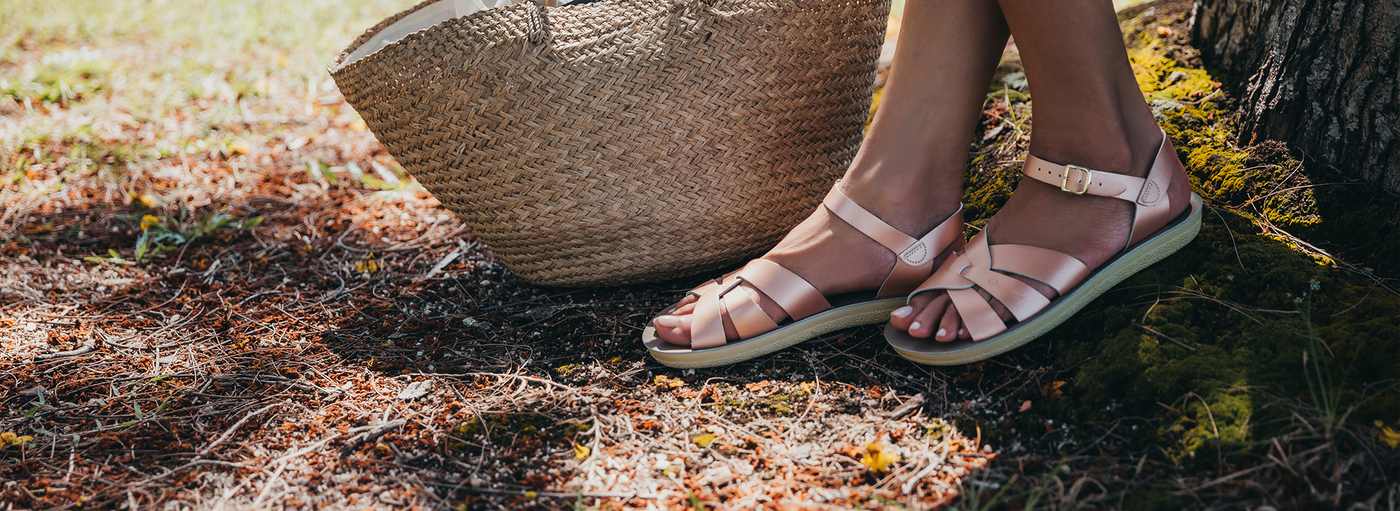
Choose the size that gives your longest foot enough length and keeps your foot on the sole.
Size up when:
- You are between whole sizes.
- Your toes touch the front edge.
- Your heel hangs over the back.
- Your foot spills over the sides because the smaller size is too short.
- You plan to wear thin socks.
- Your feet swell during warm weather.
Consider sizing down when:
- Your foot slides forward in the sandal.
- There is a large gap at the front and back.
- You cannot tighten the strap enough.
- The sandal feels unstable during normal walking.
Do not size down just because the leather feels firm. New leather can feel stiff at first. A sandal can soften with use, but it will not safely correct a size that is too short.
When width is the main problem, sizing up may not solve it. Look for a style with a different strap design or a wider shape instead.

How Do Salt-Water Sandals Fit Wide Feet?
Salt-Water sandals may work for some wide feet, but fit depends on the style. A wide foot needs enough room across the ball of the foot, not only extra length.
Look for these signs:
- Your little toe stays on the sole.
- The side straps do not cut into your foot.
- The buckle does not pull the sandal out of shape.
- Your foot does not bulge over the edges.
- You can walk without pressure at the widest part of your foot.
A style with adjustable straps may work better than a fixed slide. However, an adjustable strap cannot create extra width in the sole. If the sole is narrow under your foot, choose another style rather than forcing the buckle tighter.
How Do Salt-Water Sandals Fit Narrow Feet?
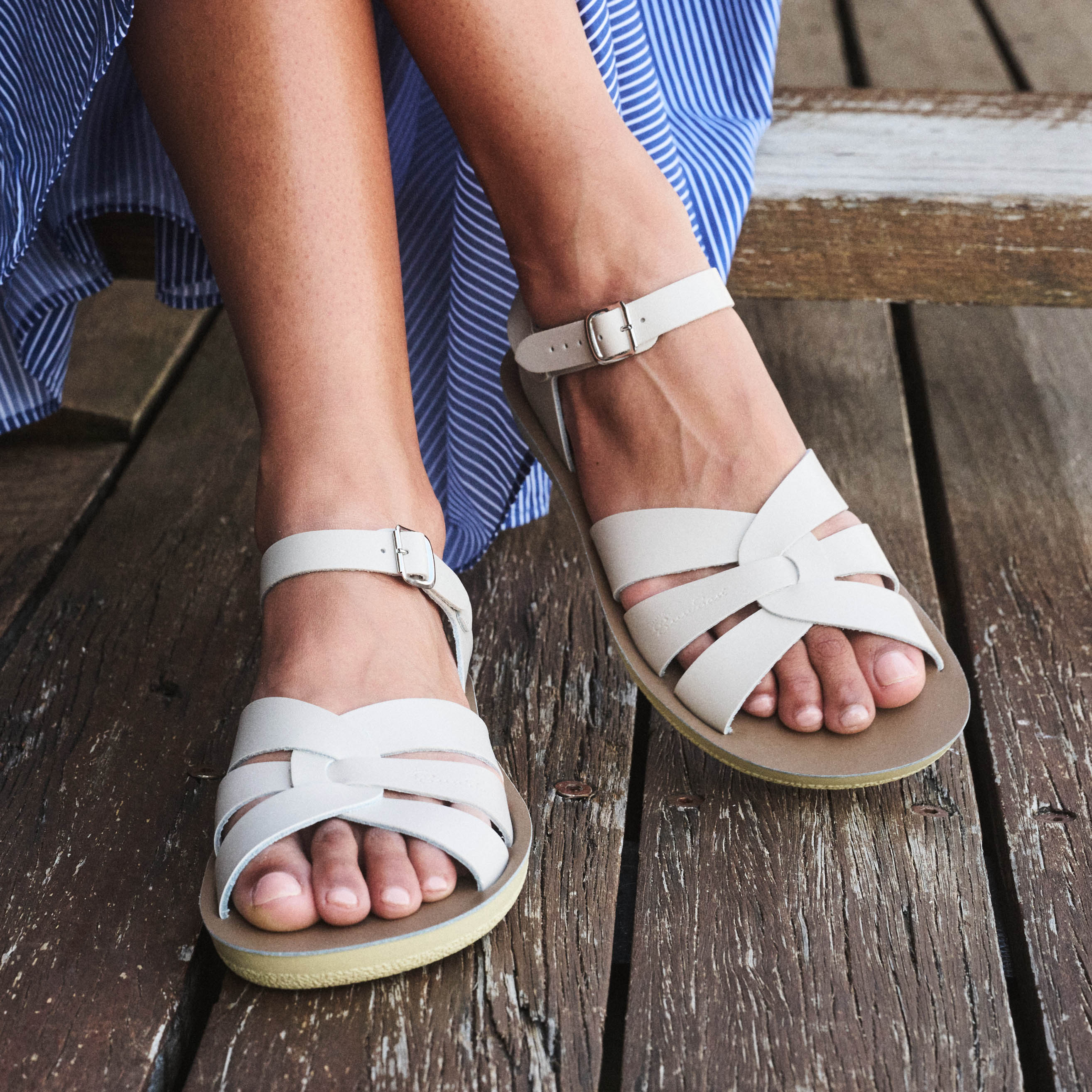
Salt-Water sandals can work for narrow feet when the straps hold the foot securely. Styles with adjustable buckles are often easier to fine-tune than loose slides.
A sandal may be too wide if:
- Your foot moves from side to side.
- Your heel slips off the sole.
- You must tighten the strap to its smallest setting.
- Your toes grip the footbed to keep the sandal in place.
Do not choose a much smaller length to solve a narrow-width problem. Your toes and heel still need enough room. A better solution may be a style with more adjustable straps.

Do Salt-Water Sandals Need to Be Broken In?
Salt-Water sandals may need a short break-in period. The leather can feel firm when new, especially around the straps and buckle.
A normal break-in period may include:
- Firm straps
- Mild stiffness when bending the sandal
- A close fit that becomes more comfortable
- Light rubbing that stops as the leather softens
Pain is not a normal sign of correct fit. Stop wearing the sandals if you develop blisters, numbness, swelling, or sharp pressure.
To ease the break-in process:
- Wear the sandals indoors for short periods.
- Use clean, dry feet at first.
- Adjust the buckle before walking outside.
- Increase wear time slowly.
- Keep a blister covering nearby during the first few wears.
Do not soak the sandals to make them stretch faster. Water can affect leather, finishes, and drying time.
Can You Wear Salt-Water Sandals in Water?
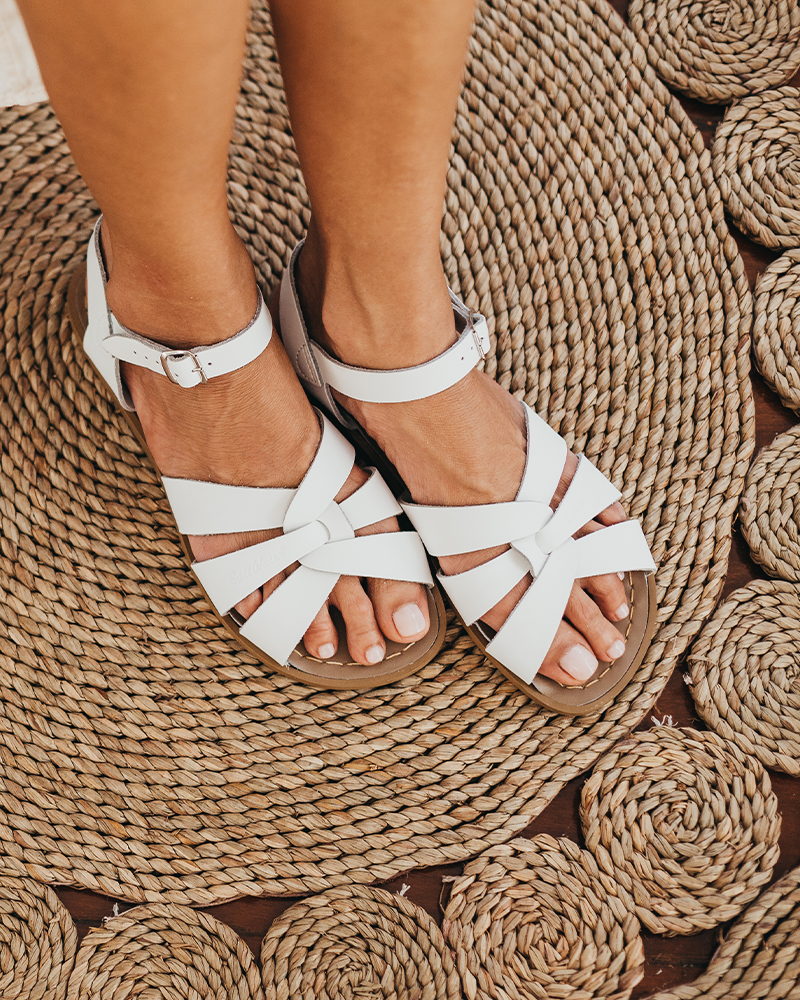
Salt-Water sandals are known for being water-friendly. Many models can be worn in water, but they are not the same as waterproof footwear.
After getting them wet:
- Rinse away salt, sand, or dirt with clean water.
- Remove excess water with a soft cloth.
- Let the sandals air-dry at room temperature.
- Keep them away from direct heat, radiators, and clothes dryers.
- Check the leather and hardware before wearing them again.
Wet leather may feel tighter or stiffer while it dries. Let the sandals dry fully before deciding that the size has changed.
Water use can also increase rubbing. A sandal that feels fine when dry may cause blisters when wet. Test a new pair for a short time before taking it on a long beach walk.
How Should Salt-Water Sandals Fit for Children?
Children’s Salt-Water sandals should fit securely without leaving a large amount of extra growing room.
Leave enough room for natural movement, but avoid buying several sizes too large. A sandal that is too long can cause:
- Tripping
- Toe gripping
- Heel slipping
- Poor control on stairs or uneven ground
Check the fit while the child is standing. Ask the child to walk, stop, and turn. Watch for toes reaching the front, the heel lifting, or the foot sliding sideways.
Children’s feet grow quickly, so check the fit during the season. Replace the sandals when the toes reach the edge, the foot spills over the sides, or the child reports pain.

Salt-Water Sandals Fit Problems and Fixes
Use the symptom to find the likely cause. Then adjust the sandal or change the size only when the evidence supports it.
| Problem | Likely cause | What to do |
|---|---|---|
| Toes touch the front | Sandal is too short | Try the next size up |
| Heel hangs over | Sandal is too short or foot sits too far forward | Try a larger size or adjust the strap |
| Foot slides forward | Sandal is too long or strap is loose | Tighten the strap; size down if there is excess room |
| Little toe hangs over | Sandal is too narrow | Try a wider-fitting style |
| Strap cuts into skin | Strap is too tight or foot is too wide | Loosen the strap; consider another style |
| Heel slips off | Strap is loose or sandal is too long | Adjust the strap; reassess the length |
| Foot feels trapped | Sandal is too short or narrow | Try a larger size or different style |
| Blisters appear | Friction, moisture, or poor adjustment | Shorten wear time and correct the fit |
If the sandal causes pain after adjustment, do not keep wearing it to “break it in.” Leather may soften, but pressure from the wrong size can continue to cause injury.
Do Salt-Water Sandals Have Arch Support?
Salt-Water sandals generally have a simple, flat sandal design rather than a shaped orthopedic footbed. They may feel comfortable for casual use, but they are not a substitute for medical footwear.
Your choice may need more care if you have:
- Ongoing foot pain
- A history of blisters
- Diabetes
- Reduced feeling in your feet
- Bunions or severe toe problems
- A condition that requires custom support
Ask a qualified health professional for individual footwear advice if a foot condition affects your walking or skin safety.
Are Salt-Water Sandals Comfortable for All-Day Walking?
Comfort depends on the fit, the style, your feet, and the surface. Salt-Water sandals can work well for casual walking, warm-weather outings, and beach use. They may not provide the cushioning, support, or shock control some people want for long walks.
Before wearing them all day:
- Test them indoors.
- Walk on a level surface.
- Check for rubbing after 15 to 30 minutes.
- Adjust the straps while standing.
- Increase wear time gradually.
A sandal that feels fine for a short errand may not feel the same after several hours. Bring another pair if you expect a long day on your feet.
Common Salt-Water Sandal Fitting Mistakes
Buying by size number alone
A U.S. size number does not show your exact foot length or width. Use the current chart and measure both feet.
Assuming all styles fit the same
Open sandals, slides, and closed-toe designs can hold the foot in different ways. Check the fit of the exact style you plan to buy.
Expecting leather to stretch in length
Leather can soften and relax. It usually cannot make a sandal that is too short become long enough.
Ignoring width
A longer sandal is not always a wider sandal. Check whether your foot stays within the sole.
Wearing them for a full day right away
New straps can rub. Start with short indoor wear and check your skin.
Using wet feet as a sizing test
Wet skin can increase friction and swelling. Test the sandals dry first, then introduce water for a short period.
Quick Fit Checklist
Before keeping your Salt-Water sandals, confirm that:
- Your longest toe does not touch the front.
- Your heel rests on the sole.
- Your foot does not hang over either side.
- The straps feel secure but not painful.
- You can walk without sliding.
- Your toes do not curl to hold the sandal.
- You have no numbness, sharp pressure, or lasting redness.
- The sandals feel stable when you turn and stop.
If all eight points are true, the fit is likely suitable for normal casual wear.
Frequently Asked Questions
Do Salt-Water sandals run big or small?
They generally fit close to standard U.S. sizing. However, fit varies by style and foot shape. Check the official chart for the exact sandal before ordering.
Should I wear socks with Salt-Water sandals?
You can wear thin socks if the style allows enough room. Measure your feet with the socks on and check that your toes and heel still stay on the sole.
Can Salt-Water sandals stretch?
The leather may soften and relax with wear. Do not expect the sandals to stretch enough to fix a short or narrow fit.
Are Salt-Water sandals good for wide feet?
Some styles may work for wider feet, especially when the straps adjust. The sole must still provide enough width. If your foot spills over the edge, choose another style or size.
How much room should be left in Salt-Water sandals?
Leave a small amount of space in front of your longest toe and behind your heel. Your foot should remain on the sole without sliding. Too much extra room can make the sandal unstable.
What should I do if one foot is larger?
Fit the larger foot first. Use the strap to make the smaller side more secure. If the difference is large, consider a retailer with a suitable exchange policy or ask a qualified footwear professional for advice.
Conclusion
Salt-Water sandals should fit securely, with your toes and heel resting fully on the sole. Start with your normal U.S. size, measure both feet, and use the larger foot when comparing the brand’s current chart. If you are between sizes, the larger size is often the safer starting point.
A correct fit should feel close but not painful. If your foot spills over the sides, your toes touch the front, or your heel slides off, change the size or choose a different style instead of relying on break-in.

Michael Smith is the Content Strategist behind The Style Hub, where fashion meets function. With a keen eye for trends and a passion for everyday style, he curates content that helps readers make smarter, more stylish choices—from the perfect pair of sneakers to must-have accessories. Michael specializes in breaking down fashion into practical, wearable insights, making style accessible for everyone. When he’s not researching the latest trends, he’s exploring how comfort, innovation, and timeless design come together in modern fashion.